The Next Evolution of Exhibition Design
Where Craft, Ecology, and Intelligent Systems Converge
Stehling’s Taxidermy × Epic Journey Design
A New Standard for Exhibits
Exhibition design is changing.
For decades, natural history displays and taxidermy installations followed a familiar model: objects were presented, information was delivered, and visitors were expected to observe.
That model no longer meets expectations.
Today’s audiences are looking for something deeper — not just information, but connection, context, and meaning. They want to understand what they are seeing, why it matters, and how they relate to it.
At Stehling’s Taxidermy and Epic Journey Design, we are developing a new approach — one that integrates traditional craftsmanship, spatial storytelling, and intelligent systems into a single, cohesive experience.
This is not about upgrading exhibits.
It is about redefining what an exhibit is.
From Specimen to Experience
Taxidermy has traditionally been treated as a static display — a preserved moment frozen in time.
We see it as something far more powerful.
A mount is not simply an object.
It is a narrative anchor — the physical center of an experience.
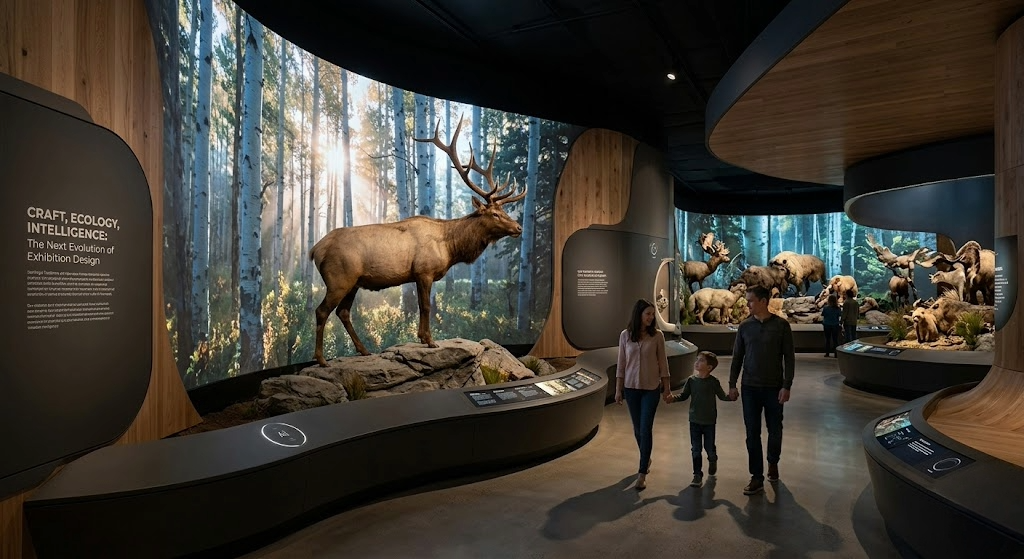
In our showroom and exhibition environments, taxidermy is no longer isolated. It exists within a carefully designed system of:
- Controlled lighting environments that shape perception and mood
- Projection layers that extend habitat and context beyond the mount
- Spatial storytelling that guides how the visitor encounters and interprets the subject
Our goal is not to enhance the specimen artificially, but to reconstruct the world it came from.
When done correctly, taxidermy shifts from representation → to interpretation.
Designing Movement, Not Just Space
Most exhibits are designed as a series of individual moments.
We design them as continuous journeys.
In our current work, we are actively developing environments that respond to how people move through them:
- Visitor pathways shaped through light, contrast, and spatial compression
- Projection systems that subtly shift based on position and pacing
- Dynamic lighting control that adapts throughout the day and across occupancy levels
The result is a space that behaves less like a static installation and more like a living system.
Visitors are not just moving through a room —
they are being guided through an experience.
AI as an Invisible Layer
Artificial intelligence is often misunderstood in exhibit design.
Many assume it should be visible — interactive screens, digital characters, or overt technology.
We take a different approach.
At Epic Journey Design, AI is most effective when it is invisible but foundational.
We are integrating AI into our environments to:
- Monitor and respond to visitor flow and density
- Adjust lighting, projection, and environmental conditions in real time
- Enable adaptive storytelling, where content depth evolves without adding physical complexity
This allows exhibits to become more responsive and intuitive — without overwhelming the visitor.
Our position is simple:
AI should not be the experience.
AI should make the experience work.
Precision Over Spectacle
There is a growing trend toward high-intensity immersive environments — more screens, more sound, more effects.
We believe that approach is fundamentally flawed.
True immersion is not created through volume.
It is created through control and intention.
Our design philosophy prioritizes:
- Focused sensory moments, not constant stimulation
- Clear visual hierarchy, guiding attention naturally
- Balanced pacing, with moments of impact and moments of stillness
When everything demands attention, nothing holds it.
Precision creates memory.
Noise creates fatigue.
Technology and Authenticity
As technology advances, so does the potential for fully simulated environments — including robotics and artificial animal systems.
These tools have value. They can:
- Expand accessibility
- Demonstrate behaviors not easily observed
- Support education in controlled environments
However, they must be used carefully.
Over-reliance on simulation risks disconnecting visitors from real ecosystems — replacing understanding with novelty.
Our approach is deliberate:
Technology should support reality, not replace it.
The goal is always to deepen respect for the natural world — not replicate it artificially.
Where Craft Meets Intelligence
What defines this next generation of exhibits is not a single innovation —
it is the integration of multiple disciplines.
At Stehling’s Taxidermy, we bring:
- Deep anatomical knowledge
- Precision craftsmanship
- A commitment to realism and preservation
At Epic Journey Design, we bring:
- Spatial storytelling
- Human-centered design
- Immersive experience development
AI and adaptive systems introduce a third layer:
- Real-time intelligence and responsiveness
Together, these elements create something new:
- Exhibits that adapt instead of remaining static
- Spaces that guide behavior instead of relying on instruction
- Experiences that are felt and remembered, not just observed
Building the Future — Now
This is not theoretical.
We are actively developing and implementing these systems within our showroom and project work:
- AI-assisted environmental control
- Interactive projection systems
- Flow-based spatial layouts
- Integrated lighting and sensory design
Each project is a step toward a larger goal:
To create exhibits that are not just informative —
but transformative.
A Shift in Philosophy
The future of exhibition design will not be defined by technology alone.
It will be defined by how well we combine:
- Authenticity — grounded in craft and reality
- Narrative — delivered through space and experience
- Intelligence — driven by adaptive systems
At Stehling’s Taxidermy and Epic Journey Design, we are not waiting for that future.
We are building it.
From Display to Impact
This is the shift:
- From object → to experience
- From observation → to engagement
- From static → to responsive
- From information → to impact
Stehling’s Taxidermy × Epic Journey Design
Craft. Experience. Intelligence.
Museums & Institutions
Planning an exhibit, a diorama restoration, or a habitat build for an institution? That work is handled by our sister company, Epic Journey Designs — immersive habitat fabrication, diorama restoration, lighting, and phased exhibit renovation for museums, nature centers and visitor centers.